· Riley Carter
How to Clean a Water Bottle (Any Material)
Most bottles that go bad were washed often enough. They were dried wrong, or the lid was never taken apart. Those two habits account for nearly every musty bottle, and both are quick to fix.
The daily rinse, in 30 seconds
If you drank plain water, that rinse holds you until the weekly wash. If there was juice, coffee, an electrolyte tab or a protein shake in there, skip straight to soap the same day. Sugars and proteins are what a smell feeds on, and warm water alone moves them around rather than lifting them out.
The weekly deep clean
Set out warm water, dish soap, a bottle brush and a small brush for the lid. Then work in this order, because starting at the lid keeps you from re-dirtying a clean body.
Take the lid apart first. Pull out the silicone gasket, unclip any straw, and separate a flip spout if it lifts out. This is the step almost everyone skips, and it is where a bottle actually goes wrong: a gasket sits in a groove that never sees water when the lid is washed whole.
Wash every piece by hand. Soap and warm water on the gasket, the straw, the spout and the threads on the bottle mouth. Use the small brush on the threads, where drink residue collects in the grooves and is easy to miss.
Brush the body. A drop of soap, warm water, and long strokes with the bottle brush down the sides and around the base. Reach the shoulder where the neck narrows, since that curve is out of reach of a swirl of water.
Rinse and dry open. Rinse until no soap is left, shake out the water, and stand everything separately: body upside down on a rack, lid parts spread out. Reassemble only when all of it is dry.
Dishwasher or hands?
minimum final-rinse temperature a home dishwasher must reach to be certified as sanitizing, which is also why thin lid parts do better in the sink
— NSF/ANSI 184 residential dishwasher standard, 2024
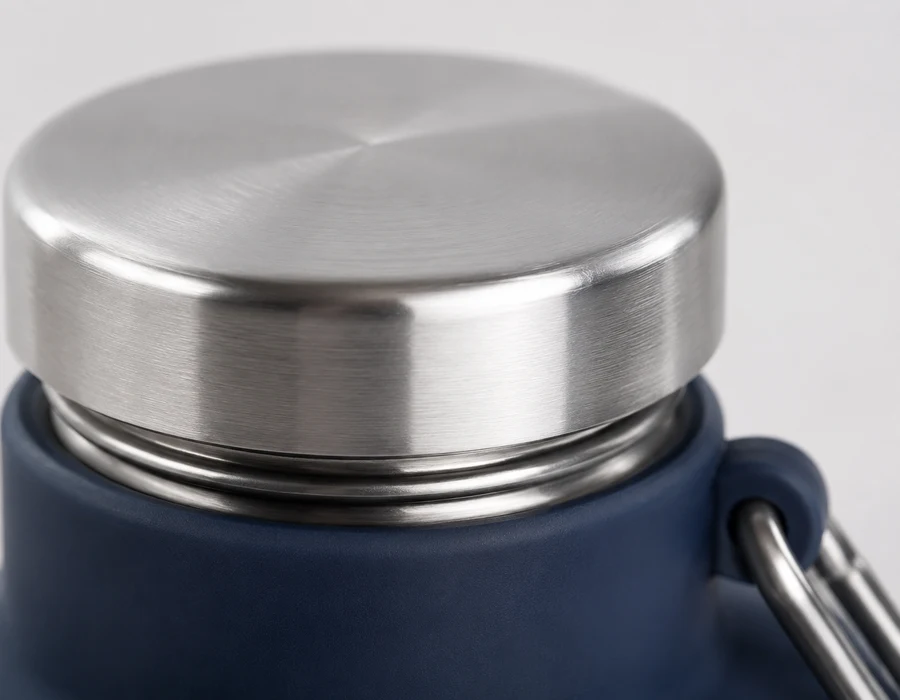
A soft silicone body is a hand-wash item. Soap and a brush clean it in one pass, because silicone is non-porous and has nothing for residue to sink into, and hand-washing keeps the cap gasket seated the way it left the factory. Our how we test page sets out the seal checks we run before a bottle ships.
Smells, film and stains
Three different problems, three different fixes. Matching them correctly saves a lot of scrubbing.
| What you see or smell | What it is | Fix |
|---|---|---|
| Musty or stale smell | Bottle was capped damp | Baking soda and warm water, overnight, then wash and dry open |
| White or chalky film | Limescale from hard tap water | Equal parts white vinegar and warm water, 30 minutes, then rinse |
| Pink or black spots | Mildew in a damp corner | Vinegar soak, scrub the spots with a brush, wash again with soap |
| Coffee or tea staining | Tannins on the surface | Baking soda paste on a brush, worked over the stain, then rinse |
the level above which the US Geological Survey classifies tap water as hard, which is where the chalky film inside a bottle comes from
— US Geological Survey water hardness classification, 2023
What changes by material
Bottle care articles usually give one routine for every bottle. In practice the body material decides two things: whether the dishwasher is an option, and what you must never touch it with. Here is how the four common materials actually differ.
| Material | Dishwasher | Avoid | Watch for |
|---|---|---|---|
| Stainless steel | Top rack, single wall only | Steel wool, bleach | Chlorine pitting the inner wall |
| Hard plastic | Top rack | Abrasive pads | Scratches that hold odor |
| Glass | Yes, with the sleeve off | Thermal shock | Chips around the rim |
| Food-grade silicone | Hand-wash | Bleach, solvents | Water left sitting in the folds |
Assembled from the care instructions we follow on our own test bench, where each bottle is washed, dried and refilled daily for weeks before it goes on the site.
The silicone row is the one with a wrinkle worth its own guide, because a folding body has creases a rigid wall does not. Unfolding it fully before you wash, and drying it open rather than folded, is covered step by step in how to clean a collapsible water bottle.
Drying: the step that decides everything
A washed bottle capped wet is a warm, sealed, damp space, and that is the one condition a smell needs. Stand the body upside down on a rack or upright with the cap off, spread the lid parts out beside it, and give it air. If you are packing for the morning, dry it the night before rather than sealing it damp overnight.
Residue left on the threads has a second cost beyond smell: it holds the gasket a fraction of a millimeter off the rim, which is one of the reasons a bottle that used to seal starts to weep. We go through all four causes in why collapsible water bottles leak.
Four things to keep away from it
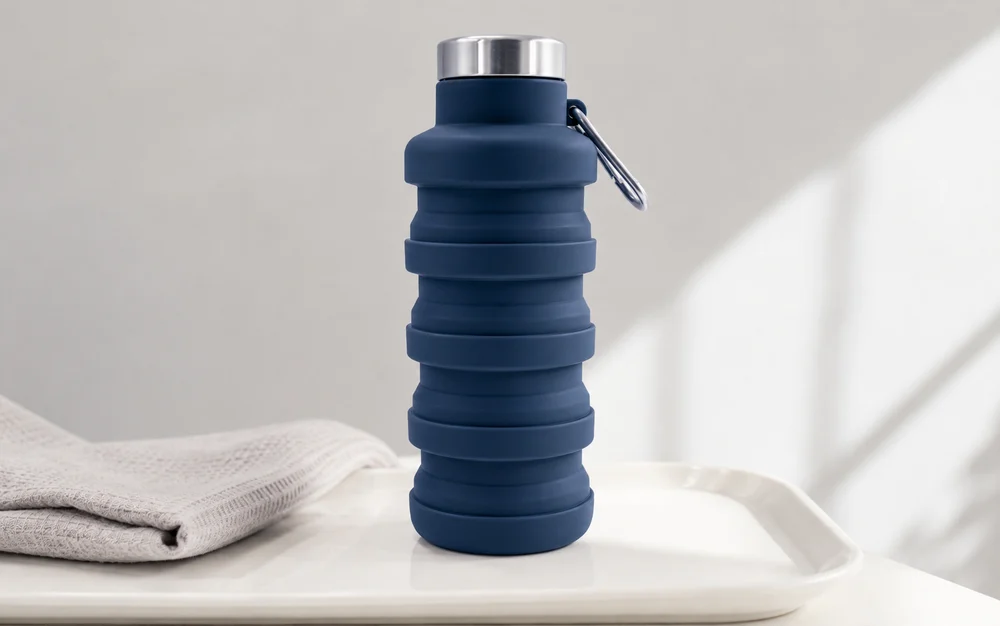
Bleach. Hard to rinse out completely and unnecessary once soap, baking soda and vinegar are on the shelf. Abrasive pads. They scratch plastic and steel, and a scratch is a place for odor to live. Rice. It dries slowly and leaves dust in the threads. A sealed cupboard. Store the bottle open or folded and empty, never capped with a drop still inside.
the capacity we clean-test to, filled to the working line rather than the brim so the cap seats cleanly without spilling
— Squishly product specs, 2026
That is the whole method: a rinse most days, one proper wash a week with the lid in pieces, the right soak for the right problem, and an open dry every single time. Do that and any bottle tastes like water for years. If you are choosing one, the buying guide covers what to look for in a cap and a fold, the material is explained on our silicone water bottle page, and the four colors are on the collapsible water bottle page. Real buyer ratings are on the reviews page, and packing one for a trip is covered in our travel and hiking guide.
Frequently asked questions
How often should I clean my water bottle?
Rinse it every day you use it, and give it a full soapy wash with a brush once or twice a week if you only drink water. Anything with sugar, milk or protein in it needs soap the same day, because those are what feed a smell.
Can I put a water bottle in the dishwasher?
Rigid stainless steel, glass and hard plastic bottles usually go on the top rack. Lids are the part to be careful with: take out the gasket and any straw first, and wash the small parts by hand so nothing warps or gets trapped wet inside a channel.
How do I get the smell out of a water bottle?
Fill it with warm water and a spoonful of baking soda, leave it overnight, then scrub and rinse. For a stronger smell, use equal parts white vinegar and warm water for 30 minutes instead. Then dry it open, which is what stops the smell coming back.
What is the white film inside my water bottle?
Limescale from hard tap water, not dirt. It is calcium and magnesium left behind as water evaporates. A soak in equal parts white vinegar and water dissolves it, and a rinse afterwards clears the vinegar.