· Riley Carter
Can You Put Hot Water in a Collapsible Bottle? Heat, Freezing and the Limits of Silicone
The question arrives in two forms. One person wants to carry tea. The other wants to know whether a hot rinse, a summer car or a night in the freezer will wreck the bottle. The answers are different, and both start with what silicone actually does at temperature.
The silicone itself is not the limit
The material gets blamed for limits it does not have, so it helps to see the numbers. They come from the technical catalog of a maker of silicone rubber compounds — the raw material, not bottles — and describe the class of material food-grade silicone belongs to.
(302°F) — the temperature at which silicone rubber can be used indefinitely with almost no change in its properties; it also withstands 200°C (392°F) for 10,000 hours or more
— Shin-Etsu Chemical, Characteristic Properties of Silicone Rubber Compounds, technical catalog, 2025
The food-contact rule points the same way. The FDA regulation that covers rubber articles intended for repeated use with food, 21 CFR 177.2600, lists silicone elastomers among the permitted materials, and the way it tests a finished article is to extract it with distilled water at reflux temperature — that is, at the boil. What food-grade means, and why every part of this bottle that touches water is BPA-free, is covered on our silicone water bottle page; this article is about the bottle around the material.
Why we still say cold and room temperature
Start with the wall. This bottle folds from 8.3 in to 4.5 in because it is one layer of silicone with nothing rigid behind it. That single wall is what lets it disappear when empty, and it is also why it carries a drink at the temperature you poured it, with nothing between the water and your hand. Pour something hot in and you are holding the drink itself, through a soft body you have to grip to drink from. Nothing breaks; it is simply not what the shape is for.
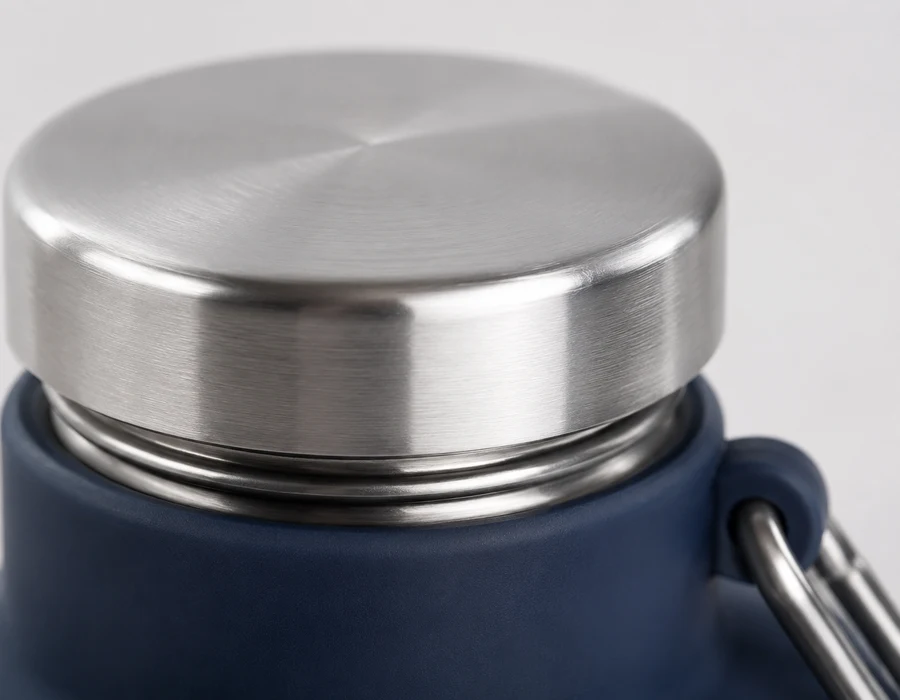
Then the cap. The stainless steel screw cap in that photo does not care about heat, but the gasket inside it is the soft part of the seal that keeps the bottle leak-proof on its side in a bag. Cap a hot drink and the air above it carries steam. A soft body has no rigid wall to take that pressure, so it lands on the gasket and the threads instead. Our guide to why collapsible bottles leak explains the pump effect that pushes water past the seal when a soft bottle is squeezed; heat is one more way of building the same pressure. That is why our material page says sticking to cold drinks protects the seal and the fold mechanism over time. The reverse holds too: let a capped hot drink cool and the air inside contracts, so a soft body pulls inward where a rigid one only clicks. Unscrew the cap and it springs back.
Warm water yes, the dishwasher no: where the washing line falls
The line that matters runs between warm and boiling. The daily rinse in our collapsible bottle cleaning guide fills the bottle a third of the way with warm water, shakes it, and stands it open to dry; the deep clean is warm soapy water and a bottle brush worked along the inner ribs. If a smell has set in, a baking soda soak or a water-and-vinegar mix does the job boiling water was supposed to do, without putting the cap and the fold through a heat cycle they gain nothing from.
The dishwasher is a heat question too. Our guide to cleaning a water bottle of any material has a section called "Dishwasher or hands?" that sets out the final-rinse temperature a home dishwasher is certified to reach, and why thin, soft parts do better in the sink. The body washes by hand, unfolded, so the brush reaches every ring, which also keeps the gasket seated the way it left the factory. The cap seal is one of the five things we check before a bottle ships; the protocol is on our how we test page.
Cold is the direction it is built for
(-76°F to -94°F) — the embrittlement point of silicone rubbers, against -20°C to -30°C for typical organic rubbers
— Shin-Etsu Chemical, Characteristic Properties of Silicone Rubber Compounds, technical catalog, 2025
That range is colder than anything a kitchen produces, which is why a bottle that has spent the night in the fridge folds exactly as it did the evening before: the cold does not stiffen the ribs, and the stainless steel cap comes out cold to the touch and seals as it always does.
"Exactly what the listing shows. The opening is nice and wide, so it's easy to drink from and easy to drop ice in."
Isabella N., verified buyer, 5 stars
That wide mouth is the summer feature: clip the bottle outside the bag with the carabiner, refill at the next fountain, and drop ice in whenever there is ice. And when a cold bottle beads up in humid air, dry it and carry on — the thirty-second upside-down test in the leak guide separates condensation from a seal that has let go.
Can you put a collapsible water bottle in the freezer?
the drop in density when water freezes — the reason ice floats, and the room a bottle has to leave for water that is going to become ice
— USGS Water Science School, Water Density, 2026
A soft body has more give than a rigid one, so ice pressing outward finds room where a hard plastic bottle would find a crack. What ice does not respect is the cap: threads meant to seat a gasket evenly do not want a plug of ice climbing into them, and a bottle frozen collapsed asks the ribs to hold a solid block in the exact crease we tell people to keep clear. So the method is short: expand the bottle fully, fill it halfway, leave the cap off, stand it upright. In the morning, top it up with cold water, cap it, and the ice does the cooling as it melts. Or skip the planning: the mouth was made wide enough that ice cubes drop straight in.
Heat from outside: sun, cars and summer
Sunlight on a hike is not a problem for the body. The same catalog that gives the heat figures above calls the weatherability of silicone rubbers exceptional: exposed to wind, rain and UV rays for long periods with virtually no change in physical properties, where ozone rapidly deteriorates most organic rubbers. A Squishly clipped to a pack in July warms with the day and drinks fine.
The exception is the one we listed among the habits that age silicone fastest: a bottle left baking on a dashboard all summer. That is hours of trapped heat every afternoon, not a walk in the sun, and it is the one place we ask you to bring the bottle inside, for the color as much as anything. Our guide to how long a collapsible water bottle lasts has the full list, and not one of those habits is about what you pour in.
What goes in, and how: the short version
Most of this table is a yes; the lines that are not repeat what our product pages already say.
| What you want to do | What happens | Do this |
|---|---|---|
| Ice cubes, cold water | The use it was built around | Drop them through the wide mouth, cap it, go |
| Warm tap water for washing | The routine in both cleaning guides | Warm soapy water, brush the ribs, dry it open |
| Hot coffee, tea, soup | Heat in your hand, steam on the gasket, walls pulling in as it cools | Keep it for cold and room-temperature drinks |
| Boiling water to sterilize | A heat cycle the cap and the fold gain nothing from | Baking soda or a vinegar soak instead |
| Fizzy drinks | Pressure against the seal | Still drinks only — see the leak guide |
| Freezer | Ice needs about 9% more room | Expanded, upright, cap off, half full |
| Dishwasher | Rinse heat the body does not need | Cap: rinse. Body: hand-wash, unfolded |
| Parked car in summer | Hours of trapped heat | Bring it inside |
Squishly is a 17 oz food-grade silicone bottle with a stainless steel screw cap and a carabiner, in Slate, Lavender, Blush and Black, that folds from 8.3 in to 4.5 in when empty. Every part that touches your water was chosen for cold and room-temperature drinks used every day: the body for the fold, the cap for the seal, the wide mouth for ice.
average rating across verified buyer reviews, four-star ratings published alongside the five
— Verified Squishly reviews, 2026
Every rating is on our reviews page, with the buyers' own photos where they shared them.
Frequently asked questions
Can you put hot water in a collapsible water bottle?
The silicone tolerates it; the bottle is built for cold and room-temperature drinks. A single soft wall passes the heat straight to your hand, a capped hot drink pushes steam pressure onto the gasket, and the body pulls inward as the drink cools. Warm water for washing is fine. Keep boiling liquids out.
Can you put a collapsible water bottle in the freezer?
Expanded, upright, cap off and about half full, yes. Water takes up about 9% more room as ice, so a bottle frozen full and capped puts that growth on the threads and the gasket. Never freeze it collapsed. Ice cubes through the wide mouth are the simpler route to the same cold water.
Can a silicone water bottle go in the dishwasher?
The stainless steel cap rinses clean in seconds. The silicone body is a hand-wash item: warm soapy water and a bottle brush along the inner ribs, then an open air-dry. Our guide to cleaning any bottle explains the rinse temperature a dishwasher reaches and why soft parts do better in the sink.
Why did my bottle pull inward after I capped a warm drink?
Because the air above the drink contracted as it cooled, and a soft body moves where a rigid one would only click. Unscrew the cap and the ribs spring back. Nothing is damaged, but it is the clearest sign that the bottle is happiest filled cold.